
Top 10 newspaper comic strips
one for each decade of the twentieth century, with some gerrymandering
By “strip”, I mean multipanel comics published in newspapers; webcomics, though spiritual successors, are something else. All my picks are American because that’s what I know. This is probably the most canonical list I’ve published on this platform, with eight “well, duh” choices, one strip whose status is rising now that Fantagraphics is done reprinting it, and one that’ll hopefully make you go “oh, I didn’t think of that but that makes sense” when you see it. (Experienced consumers can skip to the comments and yell at me for leaving out Terry and the Pirates or whatever.) Years of primary interest and rankings from The Comics Journal’s 1999 Top 100 (American) Comics (not just strips) list are included for reference. Some consumer tips are appended; if you’re reading this at the time of publication, note that Fantagraphics has a sale on until tomorrow.
Warning: Some of these comics, especially the older ones, have racially insensitive depictions of people of color, especially Africans and African-Americans. In many though probably not all cases the artists are following the conventions of their time with no ill-intent (and in Herriman’s case with some irony, given what we now know about his race.) The potential for harm is still there, however, so beware.
Winsor McCay: Little Nemo in Slumberland
Years of primary interest: 1905–11
The Comics Journal list rank: 5
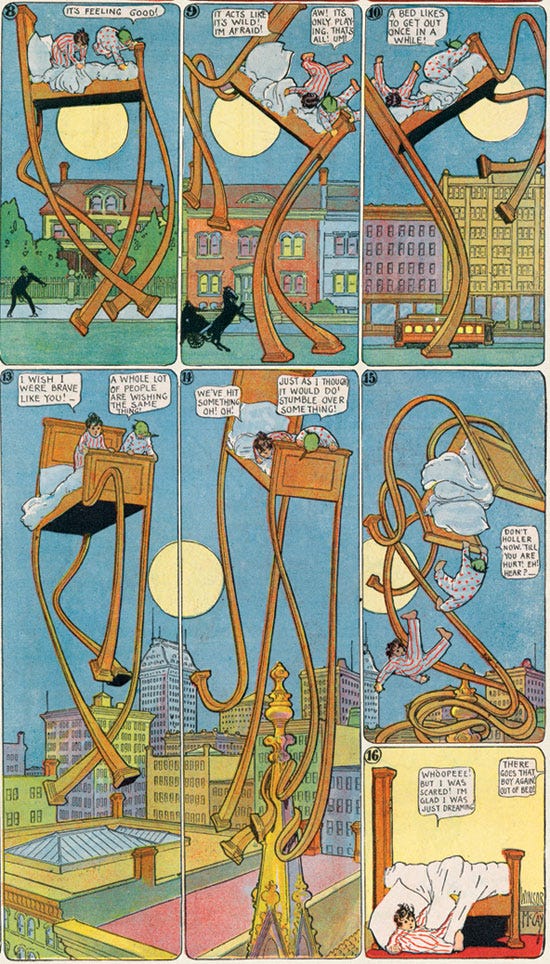
The best-illustrated continuing story in the history of comics was one of the first, which does make economic sense. Surpassing his kid-lit sources, McCay codified comic-logic as dream-logic, showing the narrative possibilities of panels on a grid and then freely breaking his own restrictions for effect. The New York Herald gave him free rein, and that run remains astonishing at every level—composition, color, character—with only the character of the Princess oddly impassive (girls, eh.) After getting poached by Hearst, McCay was much more interested in his animation, becoming foundational in a second medium; the strips were no longer quite as innovative.
How to read it: You should read it on paper; it doesn’t hit the same on a screen. The Taschen of the complete run (including revivals through 1927) is the current expensive standard, though if you happen to find an older reprint cheap, it’s the same basic thing.
George Herriman: Krazy Kat Sundays
1916–44
TCJ rank: 1

The consensus GOAT since Gilbert Seldes’s The Seven Lively Arts in 1923, its status among pop inchoolecturolls remains as uncontroversial as the Beatles’. Its greatness starts from the first Sunday and survives format restrictions and unreliable public interest. Both the Southwestern setting and the heightened language evoke a freer America, where a brick at the bean is love, and gender and on occasion racial boundaries dissolve. Even as it tails off as Herriman’s health fails, there’s the pleasure of familiarity, the Eternal Triangle (plus a lot of Mrs. Kwakk-Wakk) turning bumpily, as long as there’s a Mesa for them to permute.
How to read it: Start from the beginning; either Fantagraphics series is fine.
Cliff Sterrett: Polly and Her Pals
mostly for 1926–28
TCJ rank: 18

For a year or two, this matched and arguably surpassed the Kat H’self, with flapper Polly drawn in the prevailing pretty-girl style and her family and their surroundings getting assaulted by modernity. You can draw connections to all kinds of 1920s art happenings, but the strip’s more important for what it achieves as a comic, with expressionist coloring and skewed viewpoints that threaten the sheer rectangularness of the grid—every staircase Sterrett draws is an adventure. Before long it regresses to honorable Very Good Gag Strip status (a tell is the top strip changing from the charming animals Dot and Dash to the conventional “gee, don’t married people hate each other” Sweet Hearts and Wives.)
How to read it: The first two volumes of The Complete Polly and Her Pals from Kitchen Sink Press have the key period; they’re findable used, though not cheap. Haven’t seen the Library of American Comics reprints. Use the magic of interlibrary loan if you can.
E.C. Segar: Thimble Theatre
1928–38
TCJ ranking: 11
When Thimble Theatre started in 1919, the stars were Olive Oyl and her beau Ham Gravy, before they were usurped by breakout character… Castor Oyl, Olive’s fortune-seeking brother. In 1928, the greatest old school comic story arc starts when Castor’s uncle give him Bernice, a female Whiffle Hen (there are no male Whiffle Hens, duh—the males are Whiffle Roosters), and after Castor’s series of attempts to murder Bernice hilariously backfire, he realizes Bernice is supernaturally lucky. The obvious thing to do is hire a boat to go to a casino island, leading to the most iconic character introduction in comics.

The new guy, not the strongest but the toughest, soon usurps the strip for good, despite the best efforts of much less versatile subsequent breakout character Wimpy.
How to read it: The Whiffle Hen saga is in Fantagraphics’s I Yam What I Yam, now out-of-print and expensive and I should’ve bought it decades ago.
Crockett Johnson: Barnaby
1942–52
TCJ ranking: 68
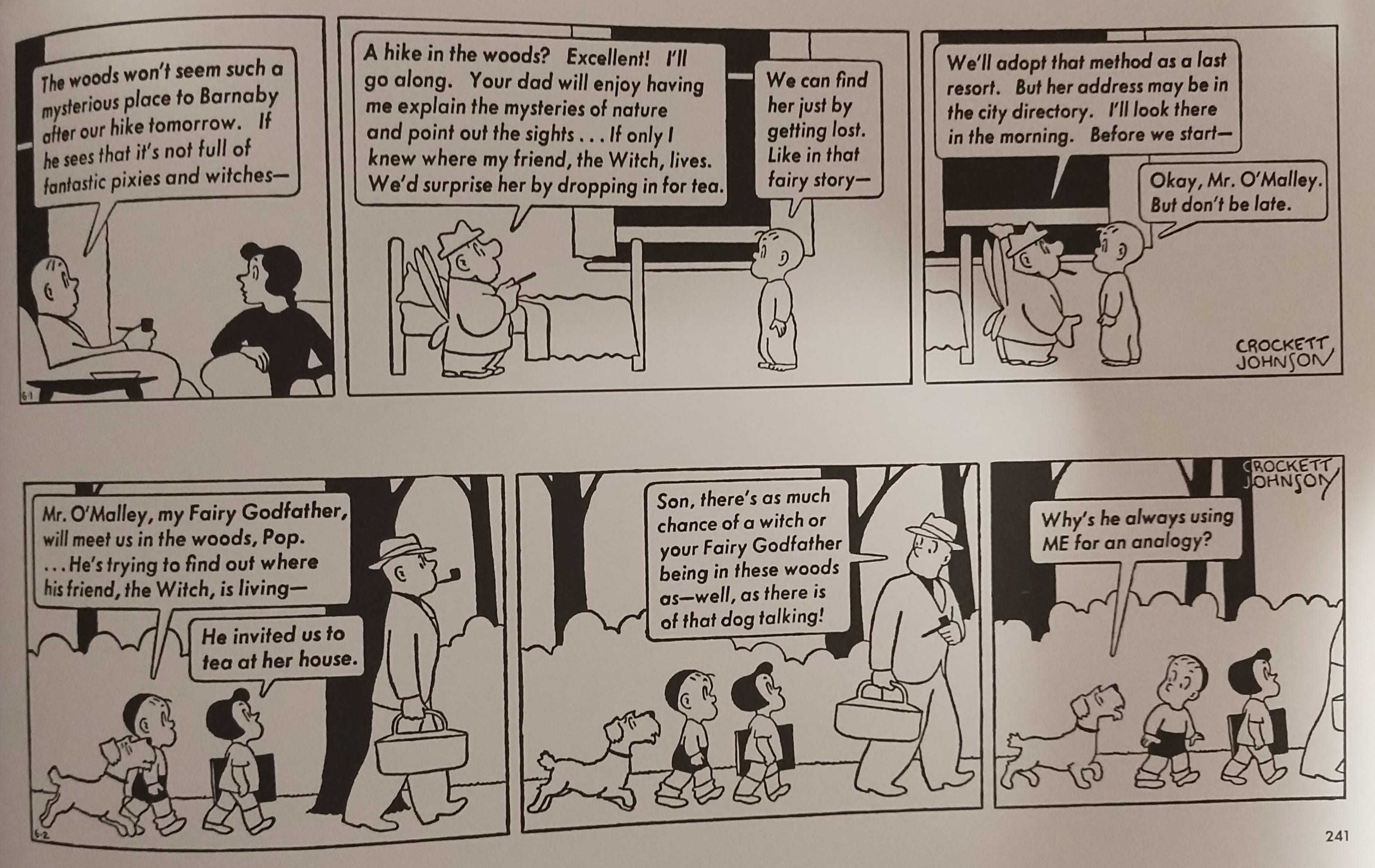
Barnaby’s parents don’t believe in his fairy godfather J.J. O’Malley; everyone else believes O’Malley too much. The first four years of the strip are the best combination of a never-ending narrative with day-to-day gaggery that I’ve read, and an important precedent for Mr. Snuffleuppagus. Johnson, later of Purple Crayon fame, somehow got a ton of expression out of stock poses and Italic Futura Medium, and snuck in a lot of satire given there was a war on. From 1946, the strip was drawn by Jack Morley, who had Johnson’s style down to a T, and sometimes written by Johnson and sometimes not; the quality remains high even if the magic is more sparing.
How to read it: The Johnson-drawn strips are in the first two volumes of the Fantagraphics reprint series.
Walt Kelly: Pogo
1948–75
TCJ ranking: 3
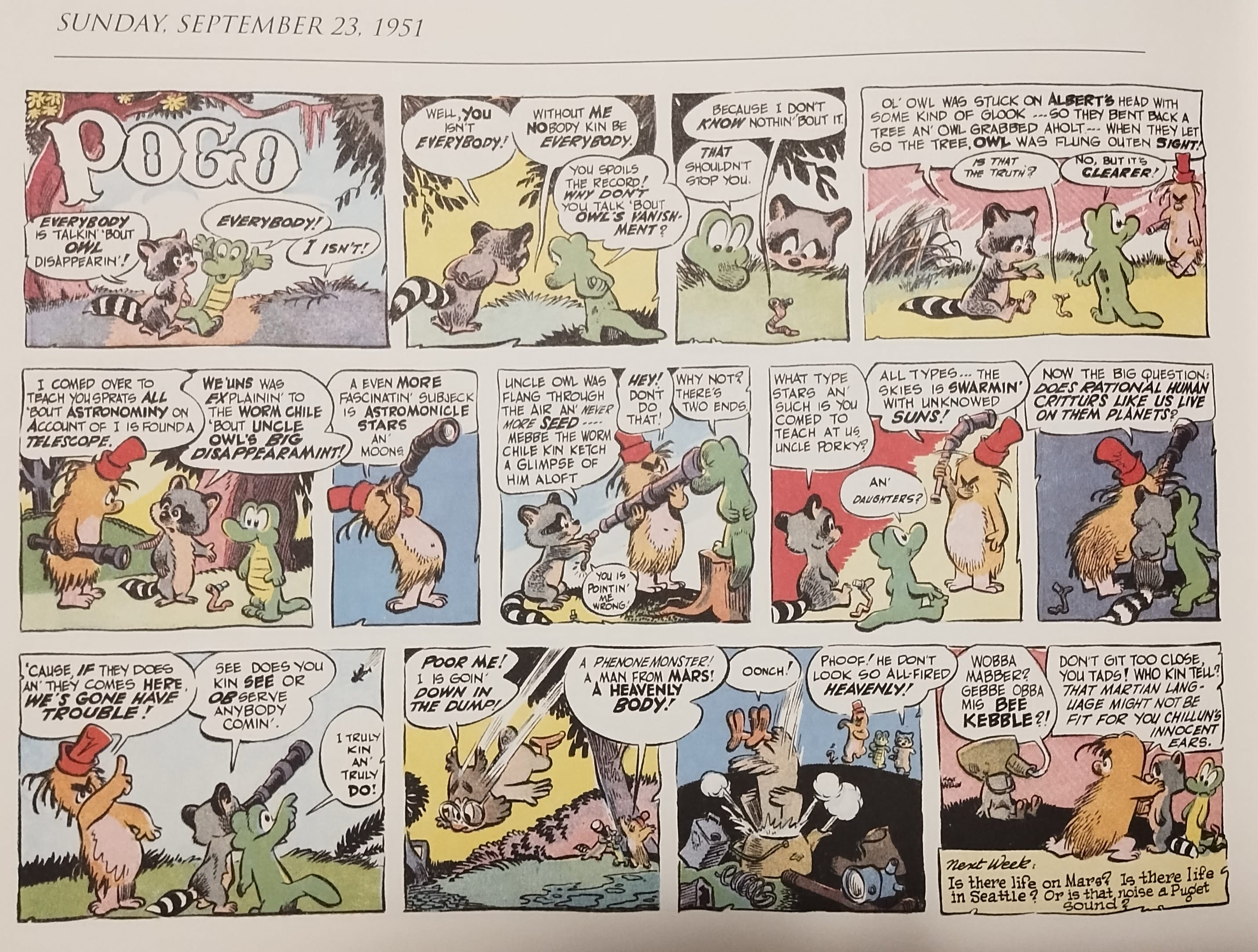
The Krazy dailies are gradually getting published, yet I still don’t think any strip was ever better seven days a week than this was in the early ’50s. Our favorite possum runs for President (and runs); everybody has their heads in space, or in a kettle, or in Albert the Alligator; Porky Pine remains the best friend any possum ever had. The sustained quality of the character art is uncanny—if you ignored the words you could get so much of what’s going on from the characters’ body language, though why would you ignore the words? As the series runs on, the political satire that peaked with Simple J. Malarkey does fizzle a little as the series runs on (this Fidel Castro guy: what if he were a goat?) The puns endure.
How to read it: The ongoing Fantagraphics reprints are in print, if expensive. You can probably also find the compilation Ten Ever-Lovin’ Years of Pogo used for a budget option.
Charles M. Schulz: Peanuts
1950–2000
TCJ rank: 2

It peaks in the mid-to-late Sixties, just as the Melendez TV specials fixed the human characterizations in stone. The last few major figures are introduced (pace Rerun), the most important for balance being Peppermint Patty—unlike Chuck, she’s good at the things boys are supposed to be good at, and a lot of good that does. I stopped keeping up with the Fantagraphics reprints after 1978, by which time the strip had clearly introduced all its best situations. Still, dipping into later years, the passage of time, Schulz’s obvious awareness of his own aging, and the unlimited possibilities of Snoopy, mean there’s always somewhere new to go, not that the hit rate of the stock tropes ever got much lower than that of Charlie Brown’s baseball opponents.
How to read it: It’s worth starting from the “How I hate him” beginning in 1950 to see how mean the strip was at first, even if that doesn’t last.
Garry Trudeau: Doonesbury
mostly for 1970–83
TCJ rank: 37

I first read this in 2002 after the Journal compared The Boondocks to it. While Doonesbury stayed controversial long after McGruder gave up on paper, it wasn’t until much later that I learned how lively it was in the Seventies—imagine being funny about Vietnam? Who knew that a Hunter S. Thompson parody was much more cutting when it was relevant? Given that he had to write with a lead time, Trudeau’s amazingly sharp on politics of the moment, from Nixon to… well there’s a lot of Nixon. Aging the characters was necessary, but the extended Boomer bummer summer that was the Seventies will always be the heart of the strip. Plus ça change.
How to read it: The Doonesbury Chronicles, Doonesbury’s Greatest Hits, and The People’s Doonesbury are all very cheap used.
Bill Watterson: Calvin and Hobbes
1985–95
TCJ rank: 36
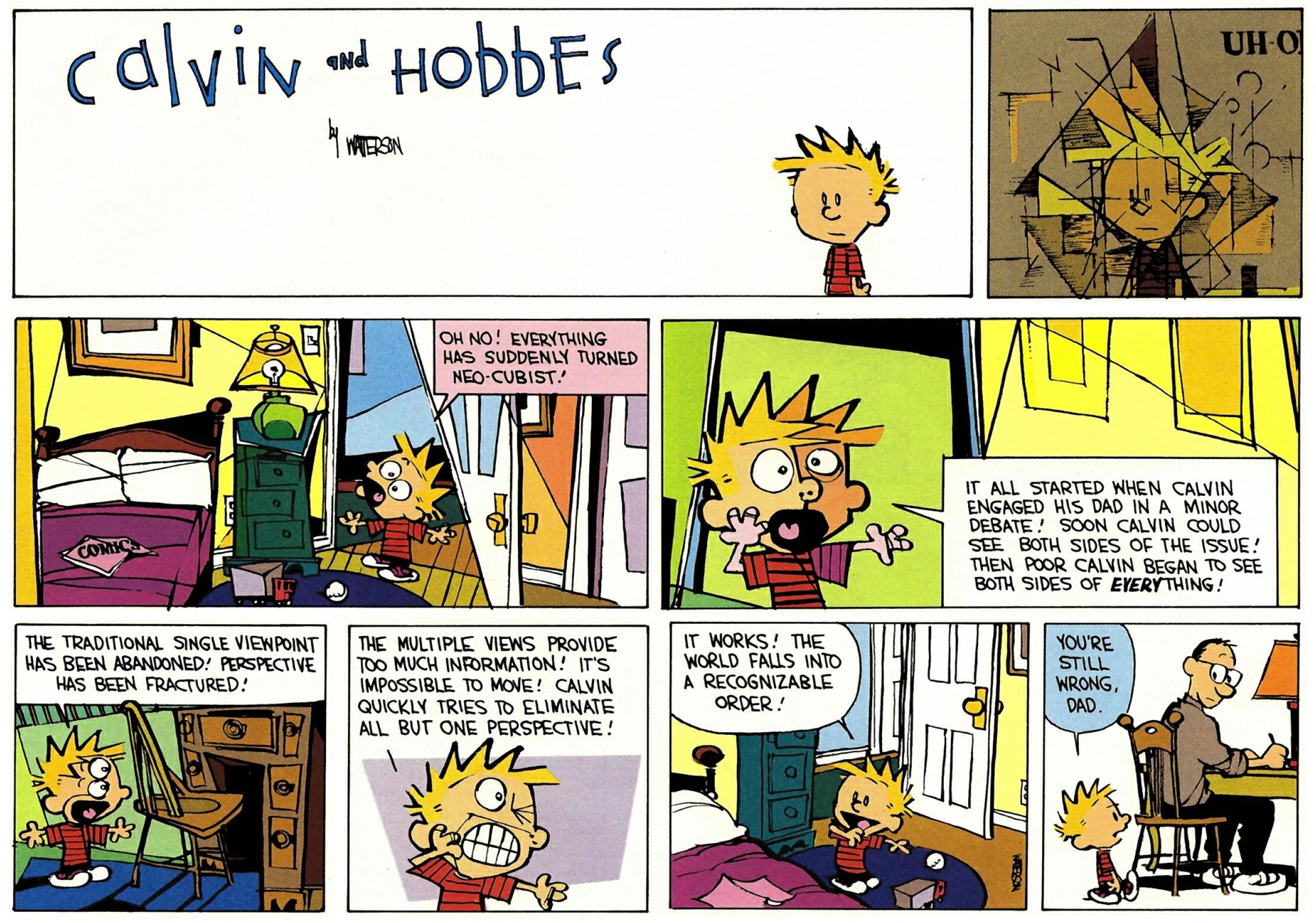
The culmination of the newspaper strip as an art form, with the caveat that Watterson had size and format restrictions that’d be anathema to the first few artists on this list. But he still gives you the imagination of McCay, the satirical sharpness of peak Barnaby and Pogo, the childhood misery and wonder of Peanuts. You don’t consistently get the sheer beauty of the Kat, but Watterson could really draw, given the chance—you can see it in some of the Sundays and in the extra art he added for the books. Anyway, the Journal ranked this below Dick Tracy.
How to read it: It’s more complicated than one might think, so just read the Wikipedia article.
Alison Bechdel: Dykes to Watch Out For
1987–2008
TCJ: not ranked
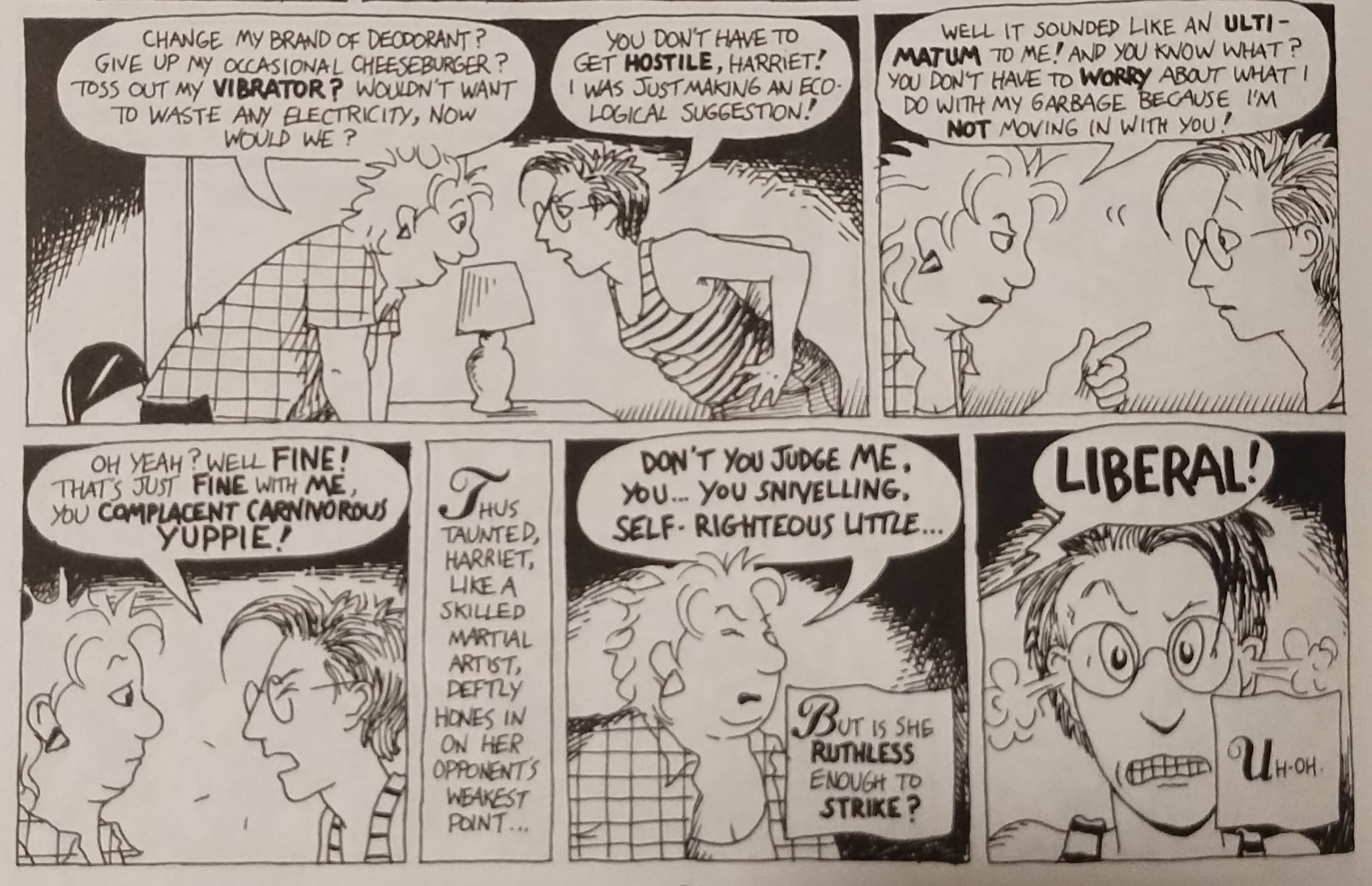
Starting with the first Mo-Clarice-Toni appearances, this became a chronicle of a subculture that creates community in the face of oppression, eventually finds much wider acceptance, yet perhaps loses some meaning in the process. That subculture being, of course, leftists. A comic that showed alt-weekly readers of all orientations ways to live, and if its politics aren’t beyond criticism, it’s telling how good a job you can do on, say, trans issues by applying “don’t be an asshole”. If I’m very glad she gave us Fun Home, I still wish she strung this out a few more months through November 2008, a natural ending point, barring us ever getting a President and Vice-President who pass the Bechdel test.
How to read it: The Essential Dykes to Watch Out For gives you most of it; if you want to fill in the gaps, there’s a Tumblr (also Internet Archive, but Tumblr’s just more apt.)
Love this. Can’t argue with any of these though I haven’t seen the ones you picked for the 40s. I do love Gasoline Alley, yes Terry and the Pirates, and Li’l Abner but wouldn’t know how to slot them in a lost like this.
This is just wonderful — thank you very much indeed. I’m especially glad you gave Doonesbury its due, and focused on its golden age.